
Journal View
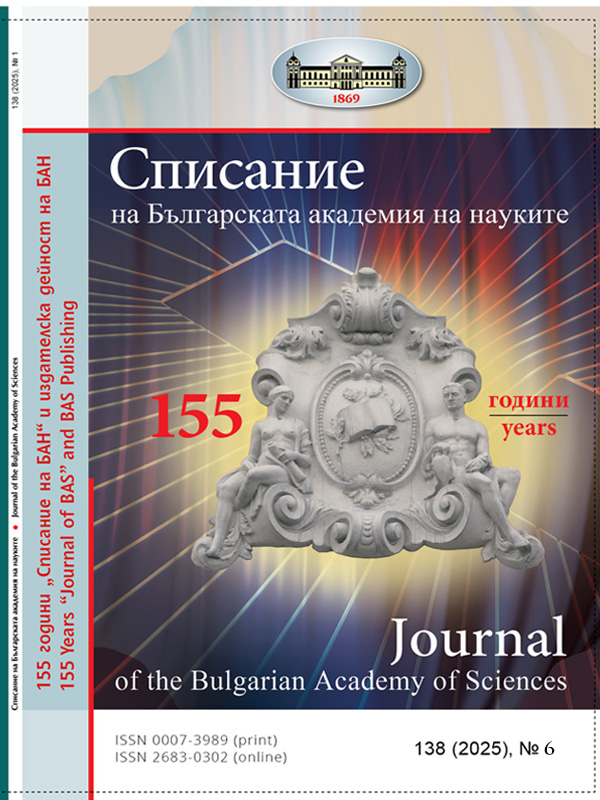
Journal of the Bulgarian Academy of Sciences
- Year: 2025
- Number: 6
- Language: Български, English
- Download Issue
-
The Early History of the Bulgarian Lev in the Context of Bulgarian Financial Culture in the 19th Century
Author(s): Ivan RoussevKeywords: Bulgarian lev, financial culture, French franc, Stefan Stambolov, 19th centuryAbstract: The article focuses on the early history of the Bulgarian lev in an attempt to present it in the context of the financial (in particular monetary) culture of Bulgarians in the 19th century. An important element of this culture is accounting knowledge and practices, as well as the scale of activity of Bulgarian businessmen, merchants, and entrepreneurs in the Ottoman market, which developed its own characteristics in the 19th century through contact between the Levant and modern Europe. The high level of financial culture is among the criteria that give grounds to assert the consolidation of the Bulgarian national market within the Ottoman market in the last two to three decades before the Liberation of 1878. The debates in the Second Ordinary National Assembly in May 1880 in connection with the discussion and adoption of the “Law on the Right to Mint Coins in the Principality of Bulgaria...” are evidence of the very good financial culture of the Bulgarian political elite. Well-argued options are discussed, which differ only in the names of the Bulgarian national currency, but not in its content, which is unanimously accepted as European. The article is based on both historical sources from the period and scientific research – my own and that of other authors.
-
Glagolitic Semiosis in the Light of the Christian Doctrine or on the Iconicity of ConstantineCyril’s Missionary Letter
Author(s): Tatyana IlievaKeywords: script, missionary alphabets, Constantine-Cyril the Philosopher, Glagolitic alphabet, semiotics.Abstract: The researcher defends the hypothesis that in the Glagolitic alphabet, invented as an original authorial script for the purpose of missionary work, as well as in the context of Eastern Christian culture each sign besides its sound and its numerical meaning also has a conceptual one. Christian dogmatics and Holy history underlie 1 the contents of the first Slavonic script as a system of conceptograms, whose separate elements become signifiers by means of the graphic signs generated in a complex geometric speculative conception – the so-called Glagolitic matrix. It represents a new further improved version of the generative model of the Glagolitic alphabet elaborated as far back as the second half of the previous century by Professor V. Yonchev. Light is thrown upon the symbolic meaning of the model and its elements (centre, cross, square, triangle, circle and spirals), whose combinations form the shape and the ideography of the Glagolitic signs. On the basis of this the researcher offers her interpretation of the Glagolitic letters ЅѢЛѠ – ЗЕМЛꙖ – ѬДОЛЬ (the first component of the letter of the iotated nazal sound). These three differ only in their position in the letter figure on the plane and form a tripartite palindrome. The problem discussed concerns the motivation for this kind of sign formation. The hitherto existing investigations of these letters from the standpoint of rationalist science and the symbolic interpretations are filled out with the researcher’s own observations and reflections, based on a profound theological, philosophical and cultural analysis. She discusses the shape of the signs, the designations of the letters, their numerical value and symbolism. By means of numerous cultural and historical comparisons in the area of overlap of theology, anthropology and dialectic the researcher reaches the conclusion that the archetypal image of the ouroboros underlies the graphic outlines of the three letters and that the similar sign formation of the two signs Ⰷ and Ⰸ can be explained not only by their close phonological value and their common derivation from previous scripts. There is also a conceptual explanation of that. And when the other two explanations are not sufficient to explain the third member of this tripartite palindrome, the sign which the researcher provisionally calls ѬДОЛЬ, the interpretation which goes beyond formal science easily explains this connection (that is otherwise incomprehensible for superficial logic) by means of the relation between the triangular letters of the followers of Pythagoras within the system of Glagolitic signs. The three signs ЅѢЛѠ – ЗЕМЛꙖ – ѬДОЛЬ prove conclusively that this hitherto undervalued approach to Constantine-Cyril’s script is not in contradiction to the other approaches but adds to them and supports them in its own way.
-
“Periodical Journal of the Bulgarian Literary Society” and the Question of Spelling
Author(s): Stoyan BurovKeywords: The Periodical of The Bulgarian Society of Letters, Marin Drinov’s spelling, Vasil D. Stoyanov, The Philological Commission, the spelling project of The Philological Commission, Manol IvanovAbstract: From the very first issue of the The Periodical of The Bulgarian Society of Letters, printed in August 1870, the Marin-Drinov concept of the composition of the Bulgarian alphabet and the orthographic basis of the Bulgarian language was adopted. Marin Drinov‘s article was published in the second issue the same year. Marin-Drinov‘s orthography, mainly because it brought the orthography into line with the living vernacular, but also because of the authority of The Periodical, even before the Liberation gradually gained supporters among writers and publishers who were outside the circle of the magazine, but especially after the Liberation, when it was imposed in Bulgarian schools as well, i.e. it acquired a nationwide character. In 1892 a seven-member commission was formed on Ceorgi Zhivkov’s initiative who was the Minister of Public Education at that time. The aim of the commission was to draw up a project for all-Bulgarian spelling. The commission, which remained in history under the name of The Philological Commission, comprised young scholars, mostly PhDs and university lecturers, who had either gained their degree or specialized in prestigious universities in Europe. The project of The Philological Commission was actually a revision of the spelling asserted by the society of letters. The public reaction against the project was extremely negative. Manol Ivanov (1867–1906), who held PhD in Slavic Philology from the University of Vienna (1893), he took part in the discussion of the project with an extensive critical article in The Periodical. The project of the Philological Committee remained only in the pages of the magazine Bulgarian Review, it was not realized. The reasons for this are many, they are well described. To them we will add the negative attitude towards the project as a whole of The Periodical and of the old members of the society itself. The society and its magazine appeared as the main conductor and guardian of the Marin-Drinov spelling.
- The Bulgarian Academy of Sciences Celebrated 156 Years since Its Establishment
-
The Cultural-Historical Mission of the “Periodical Journal of the Bulgarian Literary Society”
Author(s): Elka Traykova
-
The Cultural-Historical Mission of the “Periodical Journal of the Bulgarian Literary Society”
Author(s): Elka Traykova
- Celebration of the Day of the Enlighteners
- Congratulatory Address by the President of the Bulgarian Academy of Sciences, Corresponding Member Evelina Slavcheva
-
The Spiritual Energy of Enlightenment
Author(s): Ivan Granitski
- Awards for Scientists of BAS on the Day of the Enlighteners
-
With Responsibility for Historical Truth (40 Years since the Bulgarian-Soviet Conference on Controversial Topics about the Cyrillo-Methodian Language and about Svetoslav’s Collection (Simeon‘s Miscellany) of 1073)
Author(s): Vasil Nikolov
- Final Report of the Working Conference of Bulgarian and Soviet Scientists on the Problems of Scientific Cooperation in the Field of Humanities and on Some Controversial Issues in the Study of the Monuments of Slavic Writing from the 9th – 11th Centuries.
- Information about the work of the Bulgarian-Soviet Conference on the Issues of the Name of the CyrilloMethodian Language and about Svetoslav’s Collection (Simeon‘s Miscellany) of 1073)
-
155 Years Publishing Activity of the Bulgarian Academy of Sciences
Author(s): Yachko Ivanov
-
85th Anniversary of Academician Vladimir Ovcharov
Author(s): Boycho Landzhov
-
Dr. Stamen Grigorov the Discoverer
Author(s): Angel S. Galabov
-
One Year Later – Highlights of the Management of the Bulgarian Academy of Sciences, December 2016 – November 2024
Author(s): Julian Revalski
-
The European Molecular Biology Organization and Its Related Structures
Author(s): Aleksandar Atemin, Anastas Gospodinov
- In the Management Board of the Bulgarian Academy of Sciences: Newly Elected Director of Institute
- Professor Alessandro Maria Bruni with a Diploma for Foreign Member of the Bulgarian Academy of Sciences
- Corresponding Member Professor Nikolay Gabrovsky – Physician of the Year 2025
-
“The Mysterious Genome Longevity”
Author(s): Ivan Ivanov
-
About the Book “The Mysterious Genome Longevity”
Author(s): Alexander H. Alexandrov
-
Review of the Book “Is Bulgarian Food Magical – about the Genome, Microbiome, Food, Health and Longevity” by Academician Atanas Atanassov
Author(s): Draga Toncheva
-
Review of the book “Assassins versus Muslim Brothers” by Corresponding Member Vladimir Chukov
Author(s): Vasil Nikolov
-
The Publication “Assassins versus Muslim Brothers” by Corresponding Member Vladimir Chukov
Author(s): Dimitar Dimitrov
- Corresponding Member Iliya Rashkov
- Corresponding Member Ivan Angelov
Journal of BAS
ISSN 0007-3989 (print)
ISSN 2683-0302 (on line)
150 Years
"Journal of the BAS"
Sections in the Issue
In the issue you can read articles from the following sections.